Featured Projects
Back to projectsPageRank Research Sandbox
Summary
Explores ranking strategies via deterministic graphs, sampling approximations, and convergence diagnostics.
Problem
Ranking nodes consistently requires understanding convergence and runtime trade-offs across graph sizes.
Approach
Built deterministic test graphs, compared sampling-based approximations to iterative solvers, and logged runtime/contraction diagnostics for each teleport probability.
Highlights
- • Designed deterministic graphs to validate convergence and teleport parameters.
- • Logged runtime profiles for sampling vs. iterative methods with the same seed.
- • Captured diagnostics (residuals, norm) so deviations are easy to inspect.
Results
Iterative runtime (10k nodes)
TBD
Profiling under way.
Sampling variance
TBD
Will add confidence intervals.
Evaluation
Iterative PageRank vs. sampling-based approximation
Multiple deterministic graphs (purpose-built)
Baseline: Uniform teleport probability
Limitations
- Sampling variance needs quantification before production adoption.
- Real-world link graphs might have heavier tails than the deterministic test sets.
In progress: adding benchmarks and visuals.
Trade-offs
- • Sampling approximations run faster but introduce variance; iterative solves are stable but compute-heavy for large graphs.
- • Deterministic graphs simplify analysis but need to be mapped back to noisy real-world link data.
Next improvements
- • Surface convergence tolerance vs. runtime so downstream teams can pick the right dial.
- • Compare telemetry on actual link graphs when resources allow.
Links
Data needed
- • Repo link
- • One screenshot
- • One metric/benchmark
- • One short demo artifact
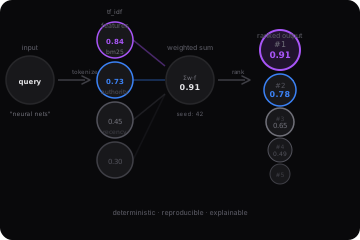
In progress: adding benchmarks and visuals.