Project
Atomic STEM Modelling & Image Analysis
Geometry-resolved HAADF-STEM image formation, interpretable surrogate modelling, and controlled validation against abTEM/multislice references.
Overview
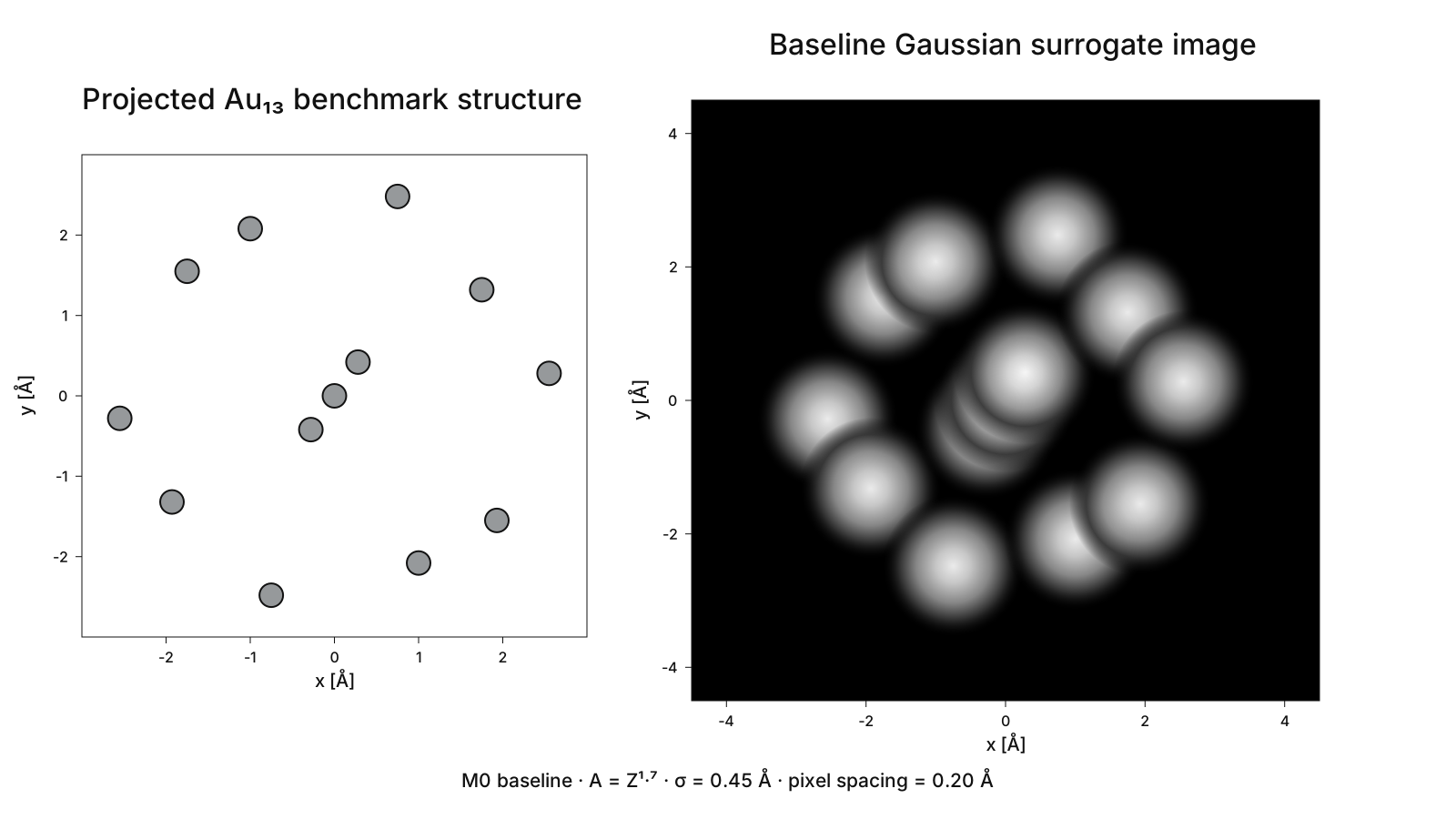
This research programme studies how atomic-resolution HAADF-STEM images can be represented, compared, and interpreted without assuming that one approximation is valid everywhere. A central theme is deciding what image order or model complexity is justified by atomic geometry and numerical evidence.
The frozen Paper 1 study, “Geometry-Resolved Few-Body Decomposition of HAADF-STEM Image Formation,” uses matched static-lattice multislice calculations to separate one-body, pair, and higher-order image contributions. It shows that tested non-column Au2 images can already be approximately additive at the full-image level, while strong projected overlap in Au3 can leave substantial residuals beyond exact pair order. The reported applicability boundary is operational and grid-resolved, not a universal physical transition.
Related work develops geometry-aware surrogate models, uncertainty-aware structural inference, numerical robustness checks, and reproducible scientific software.
Problem
Atomic-resolution HAADF-STEM interpretation depends on both image-formation physics and the approximation used to represent it. Independent atomic addition can be adequate in some geometries and inadequate in others, while full multislice simulation is more expensive. The scientific problem is therefore to identify defensible validity regimes, quantify approximation failure, and preserve a trustworthy route back to high-fidelity simulation when simpler representations are not adequate.
Approach
The research uses matched atomic subsets, fixed scan geometry, and controlled abTEM/multislice references. Image-level inclusion–exclusion separates singleton, pair, and higher-order contributions. Development choices are separated from independent validation, and numerical robustness is checked without silently treating post-hoc evidence as confirmatory. Complementary metrics distinguish full-image reconstruction, weak residual fidelity, global amplitude effects, and residual-field stability.
Outcome
Paper 1 is scientifically frozen and submission-ready. Its main result is geometry-dependent effective image order: the authorized non-column Au2 validation cases are approximately additive at sub-percent full-image error, whereas the tested beam-aligned and near-overlap Au3 controls retain substantial higher-order image residuals after every exact matched pair contribution is included.
The broader project continues with interpretable surrogate modelling and uncertainty-aware inference. No claim is made that one surrogate universally replaces multislice simulation.
Tradeoffs
Model complexity should follow geometry and evidence. Image-comparison metrics must be interpreted according to their scientific target, and apparent numerical agreement should not be confused with universal physical validity or human perceptual similarity.
Technical Notes
Versioned supporting technical notes linked to this project:
Professional profile
Continue from the evidence
See how this work fits into my broader computational science and software engineering background, or get in touch about relevant work.