Technical Notes
From One-Body Representation to Interaction-Aware HAADF-STEM Surrogates
A visual technical note on the current surrogate architecture: an empirical one-body representation, interaction detection, regime selection, independent correction validation, and high-fidelity fallback.
Public supporting technical material. Scholarly status: not peer reviewed. Protected validation cases are excluded; see Scope for details.
Scope
This note explains the current research architecture using public methodology and synthetic illustrations. The original Gaussian model is shown only as a historical baseline. It does not release protected validation cases, current unpublished performance numbers, gate thresholds, or paper-critical conclusions.
Release boundary
The diagrams below describe model architecture and validation logic. They do not expose held-out validation cases, current performance values, or unpublished numerical gate thresholds.
Current scientific question
The working question is no longer whether a fixed Gaussian can approximate a STEM image. The question is when an accurate one-body representation is sufficient, when non-additive interaction becomes resolvable, and when extra model complexity is justified.
How the surrogate architecture changed
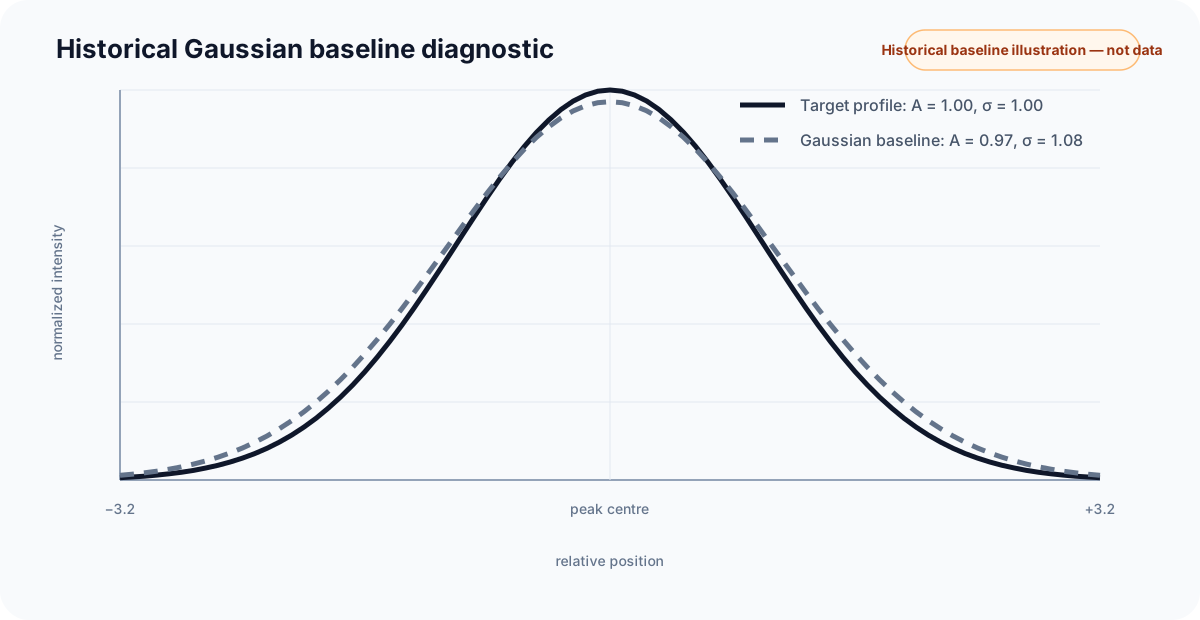
The Gaussian is now a baseline
The analytical Gaussian representation remains useful as a simple historical baseline and diagnostic. It is not the current one-body surrogate. The active one-body representation is empirical and accounts for sampling phase and depth.
Historical Gaussian baseline diagnostic
Phase/depth-aware one-body representation
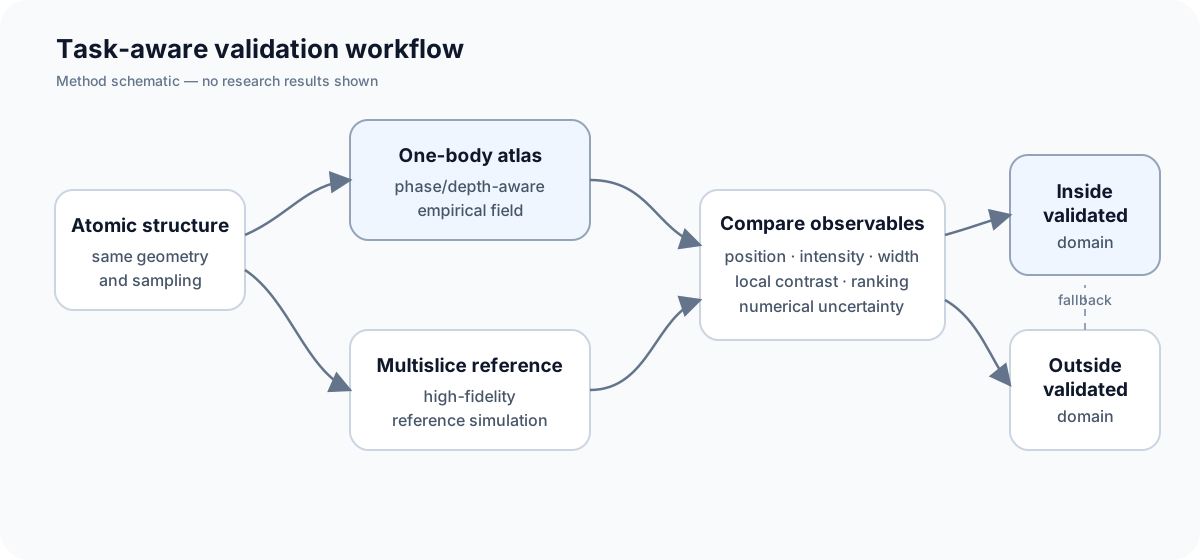
Validation workflow
Interaction is a regime question
Detecting interaction is not validating a correction
Current validation stack
Table 1
| Layer | Question | Role |
|---|---|---|
| Numerical floor | How much does the reference change under numerical refinement? | Sets the nuisance scale |
| One-body representation | Are isolated-atom fields represented accurately across relevant conditions? | Establishes the additive baseline |
| Interaction detectability | Is non-additivity distinguishable from the numerical floor? | Determines whether interaction is resolvable |
| Correction validation | Does a proposed interaction correction generalize on held-out cases? | Tests whether extra complexity is usable |
| Decision level | Does the selected model preserve the intended scientific decision? | Defines task-level adequacy |
Numerical uncertainty remains part of the model decision
Interaction should not be called resolvable merely because two simulated images differ. The physical non-additivity signal has to be interpreted relative to variation introduced by numerical refinement of the high-fidelity reference.
How Paper 1 and Paper 2 connect
Paper 1 establishes the interaction hierarchy: what non-additive terms appear and when pair or higher-order contributions matter. The active Paper 2 direction asks when that complexity is needed locally and whether geometry can select the appropriate modelling regime.
Public-release boundary
Table 2
| Public in this note | Not released here |
|---|---|
| Model definitions and evaluation concepts | Protected validation cases |
| Illustrative calculations | Unpublished performance measurements |
| Metric definitions and reporting structure | Paper-critical conclusions |
| Reproducibility requirements | Collaborator-sensitive material |
References
Table 3
| Reference | Link |
|---|---|
| K. Sukuta et al., Nanocluster structure deduced from AC-STEM images coupled to theoretical modelling (2017). | DOI 10.17586/2220-8054-2017-8-6-723-731 |
| K. S. Bersha, A. Peña-Torres, and H. Jónsson, From AC-STEM Image to 3D Structure: A Systematic Analysis of Au55 nanocluster (2021 preprint). | arXiv:2105.04270 |
| C. Dwyer, Simulation of scanning transmission electron microscope images on desktop computers (2010). | DOI 10.1016/j.ultramic.2009.11.009 |
| C. Ophus, A fast image simulation algorithm for scanning transmission electron microscopy (2017). | DOI 10.1186/s40679-017-0046-1 |